%20800x138px.png?width=200&height=35&name=I%20Can%20Read%20Marketing%20Logo%20(White%20Background)%20800x138px.png "I Can Read Marketing Logo (White Background) 800x138px")

How to Teach Your Child to Read: A Step-by-Step Guide for Singapore Parents
by I Can Read Singapore on 23 Jul 2026
To teach your child to read, build the skills in a natural order — spoken language and listening first, then awareness of the sounds in words, then matching those sounds to letters, then blending letters into words, and finally fluency and understanding. You don't need to be a teacher to do this well. The three things that help most are reading aloud together every day, talking and playing with sounds, and keeping practice short, frequent and positive — adjusted to your child's age and stage.
Here's how that journey unfolds, what to focus on at each age, and how to support it at home in Singapore.
What are the stages of learning to read?
Reading is built on a sequence of skills, each one supporting the next:
- Oral language — the words, sentences and ideas your child hears and uses every day. This is the soil everything else grows in.
- Sound awareness (phonological awareness) — hearing that “cat” starts with /k/, that “sun” and “fun” rhyme, or clapping the beats in “ba-na-na”.
- Letter–sound knowledge (phonics) — connecting those sounds to the letters and patterns that represent them, so words can be decoded.
- Blending and decoding — putting sounds together to read a whole word like “sh-o-p → shop”.
- Fluency — reading smoothly and at a comfortable pace, so attention is freed up for understanding.
- Comprehension — understanding, questioning and thinking about what's been read.
A strong reader needs all of these, which is why no single skill — phonics included — is the whole answer on its own.
How do I teach my child to read at home?
Keep it simple and daily. A short, predictable routine beats long, occasional sessions. Aim for ten to fifteen relaxed minutes a day.
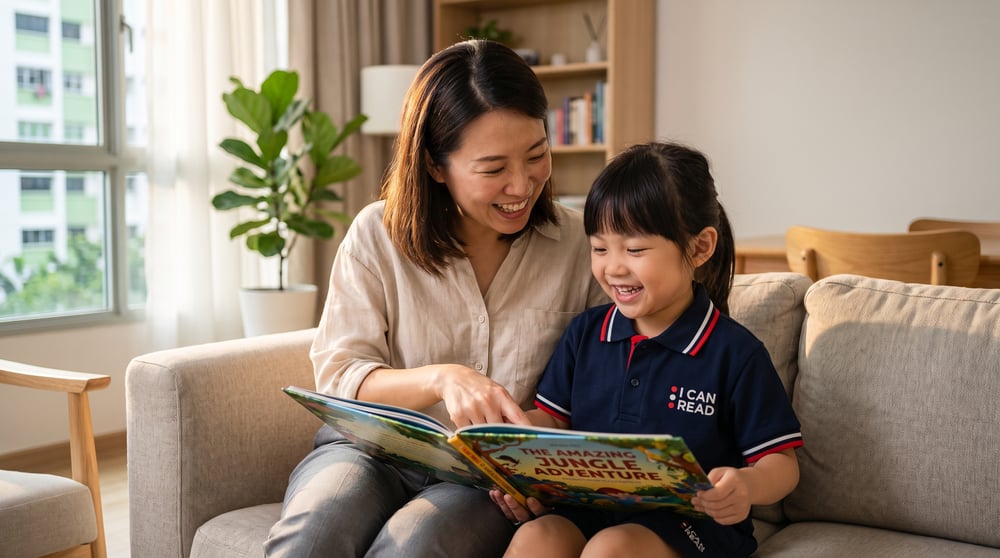
- Read aloud together every day, and let your child see you enjoying books too. Run your finger under the words now and then so they connect print with speech.
- Talk a lot. Narrate your day, ask open questions (“what do you think happens next?”), and build the vocabulary that reading will later draw on — especially valuable in Singapore's bilingual environment, where rich spoken English at home gives your child a strong base.
- Play with sounds. Rhyming games, “I spy something starting with /m/”, and clapping syllables build the sound awareness that makes letters click.
- Make print part of life. Point out words on signs, MRT stations, menus and packaging around Singapore so reading feels useful, not just a lesson.
And if Primary 1 is on the horizon, this calm daily habit is one of the best ways to ease the transition — long before any formal pressure begins.
Age by age: what to focus on
Toddlers (around 1–3)
Focus on love of books and language: board books, nursery rhymes, songs, and lots of talking. There's no need for letters yet — you're building the foundation.
Preschool (around 3–4)
Introduce playful sound awareness (rhyming, first sounds) and start naming a few letters your child cares about — usually the letters in their own name. Keep it game-like.
Kindergarten (around 5–6, K1–K2)
This is when systematic phonics usually begins: linking sounds to letters in a sensible order and blending simple words. Pair it with plenty of reading aloud so meaning stays front and centre.
Entering Primary 1
Shift towards fluency and comprehension — reading short books independently, retelling stories, and growing the vocabulary needed for school. A confident reader starting P1 has a real head start.
How does phonics help my child learn to read?
Phonics gives your child a tool to read words independently. Instead of memorising each word by sight, they learn the link between sounds and letters and can work out an unfamiliar word like “rain” for themselves. Taught in a clear order, it gives an early, confidence-building sense of “I can do this myself.”
It's worth remembering that phonics is the on-ramp, not the whole road. Once a child can decode, the focus moves to fluency, vocabulary and comprehension — which is why phonics works best inside a complete reading programme rather than on its own.
What are the most common mistakes parents make?
- Pushing too early or too hard. Drilling letters before a child is ready can make reading feel like a chore. Follow readiness, not a deadline.
- Skipping the sound-awareness stage. Jumping straight to letters without playing with sounds first makes decoding harder.
- Correcting every error. Constant correction drains the joy; praise effort and let small mistakes go.
- Stopping reading aloud once a child can read. Reading to your child — even older children — keeps vocabulary and a love of stories growing.
- Comparing to other children. Reading develops on very different timelines; a slower start is not a verdict.
When should I consider a reading programme or an assessment?
It's never too early to start. Many parents bring their children for a reading assessment not because there's a concern, but because they want to understand their child's current reading ability and help them build on it. Some children already enjoy books and are eager to learn more, and I Can Read's programmes can help accelerate their progress and strengthen their literacy skills.
An assessment is equally valuable if your child is finding reading difficult, lacking confidence or avoiding books. It helps identify exactly where they are in their reading journey and what support will help them progress most effectively.
At I Can Read, the journey runs from early reading foundations through to comprehension and Primary English. A free assessment gives you a clear picture of your child's current ability and the most appropriate next step for their learning.



.svg)
